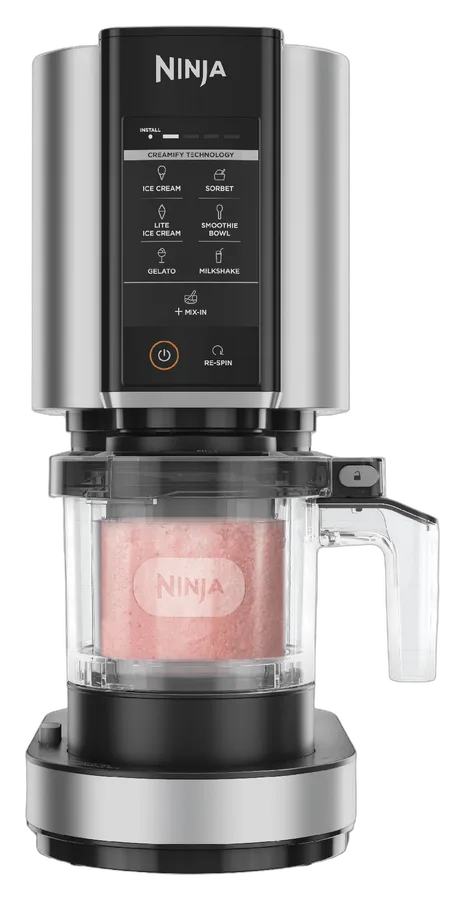
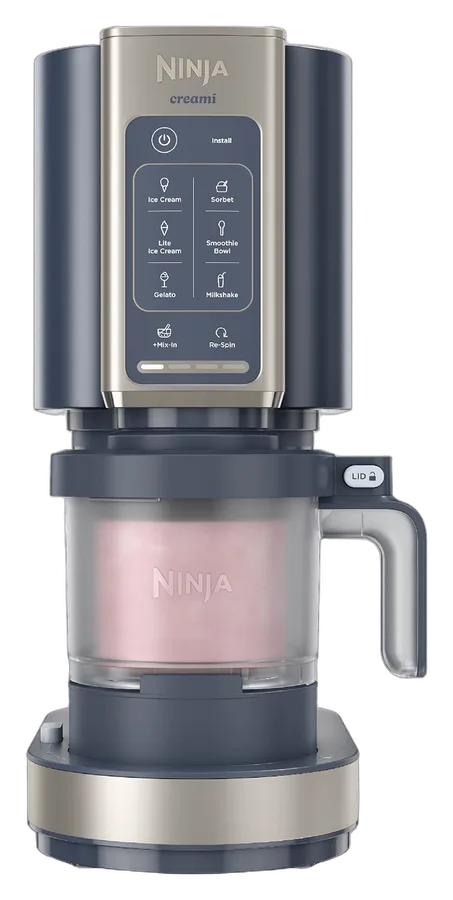
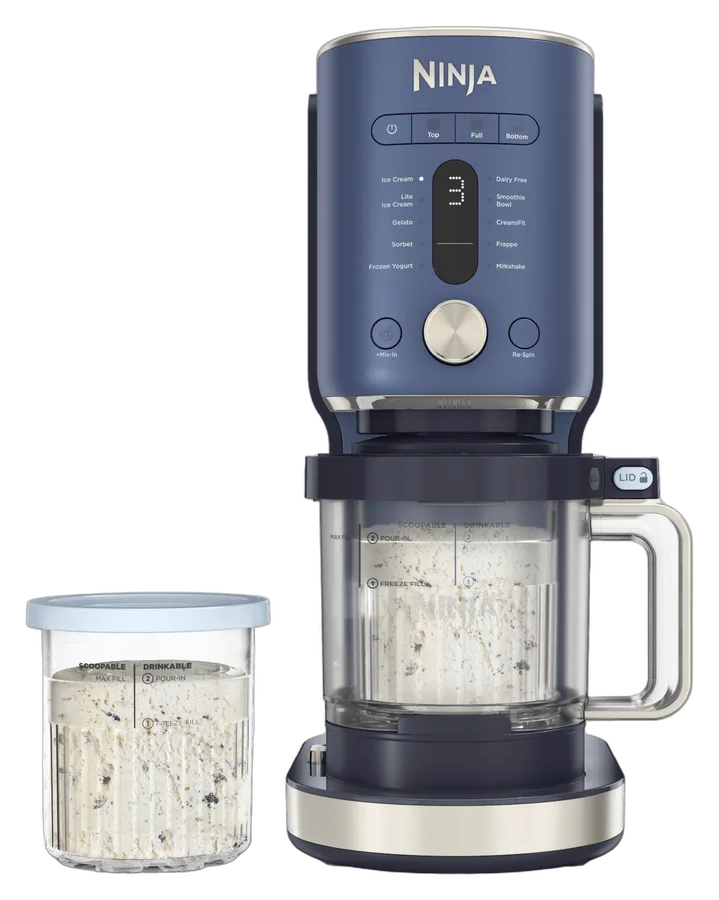
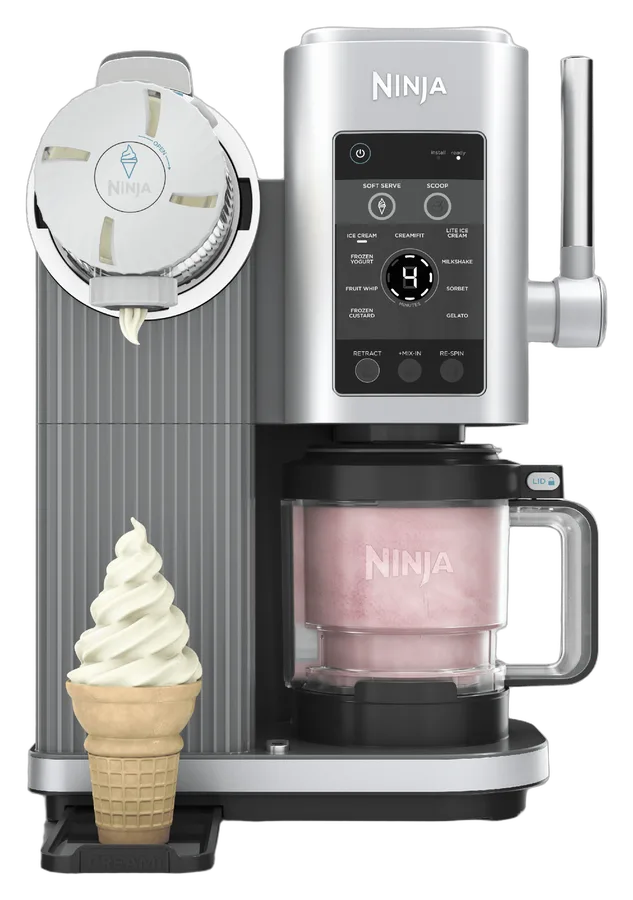
A powdery or crumbly pint is the most common surprise on a Ninja CREAMi, and Ninja's own owner's guide names it in the troubleshooting section: "Frozen treat looks crumbly or powdery after processing" (Ninja NC300 owner's guide). It is almost never a fault with the machine. It means the frozen block was too hard for the paddle to whip into something creamy in one pass, and there are two reasons a block gets that hard.
Why does Ninja CREAMi ice cream come out powdery?
Ninja's guide gives two causes, and both come down to how much of the water in the pint is frozen solid:
- The base is too cold. "When bases are frozen in very cold freezers, they may come out crumbly." Ninja says RE-SPIN "is often needed when the base is very cold (below -7°F, -22°C)."
- The recipe is too low in fat or sugar. "The proportion of fat or sugar may be too low in your recipe."
Why does cold make it crumbly?
Ice cream is never completely frozen. Food scientist H. Douglas Goff explains that dissolved sugar lowers the freezing point, so as water freezes out, the syrup left behind gets more concentrated and freezes at an even lower temperature. At a typical serving temperature of about -16°C (3°F), only about 72 percent of the water is frozen; the rest is a thick syrup that makes ice cream scoopable (Goff, University of Guelph). ThermoWorks gives a similar picture: about a fifth of the water stays unfrozen even at 0°F, -18°C (ThermoWorks).
The colder the freezer, the more of that syrup freezes too. Below Ninja's -7°F limit, there is too little liquid left to bind the shaved ice into a smooth mass, so the paddle produces something closer to frozen powder.
Why do low-fat and low-sugar bases come out powdery?
They have less of the two things that keep ice cream soft. Sugar holds water unfrozen, as above. Fat gives a smooth, creamy body, Goff notes, and milk solids help hold air. A base made mostly of water, skim milk or protein shake with little sugar has less unfrozen syrup at any freezer temperature, so it freezes harder.
Ninja's recipes say the same. Its low-sugar ice cream pages warn that in a very cold freezer the ice cream "may look crumbly" and to run RE-SPIN if it does (Ninja Test Kitchen, Low Sugar Lavender). Its Deluxe guide adds, for the frozen yogurt program, to use full-fat yogurt with added sugar and not to process non-fat or unsweetened yogurt (Ninja NC501ANZ guide).
Does the kind of sugar matter?
Yes. Goff explains that freezing point depression depends on the number of dissolved molecules, so smaller sugars such as fructose and glucose make a softer ice cream than the same weight of table sugar (sucrose). Swapping sugar for a sweetener used in tiny amounts can leave the base with fewer dissolved molecules, less unfrozen water and a harder block.
How do you fix a powdery Ninja CREAMi pint?
Work through these in order. Ninja's guide allows one program at a time: lower the bowl and check the texture between runs.
| Fix | When to use it | Source |
|---|---|---|
| Run RE-SPIN | First, for any crumbly or powdery result | Ninja owner's guides |
| Run RE-SPIN a second time | Still dry after one | Tasting Table |
| Add 1 to 2 tablespoons of milk, then RE-SPIN | Still dry after RE-SPIN | Ninja milkshake recipes; Tasting Table |
| Let the pint sit a few minutes before processing | Next time, if the freezer runs very cold | Ninja troubleshooting |
| Set the freezer between 9°F (-13°C) and -7°F (-22°C) | Pints are regularly powdery | Ninja owner's guides |
| Add fat or sugar to the recipe | Powdery even at the right freezer temperature | Ninja troubleshooting; Goff |
1. Run RE-SPIN
RE-SPIN is "designed to ensure a smooth texture after running one of the preset programs" and "can be used on a crumbly or powdery pint to make it more creamy," Ninja says. Run the original program first, check, then RE-SPIN. Tasting Table suggests re-spinning "once or twice until a desired, spoonable creaminess is reached" (Tasting Table).
The one exception: if you plan to add mix-ins, do not RE-SPIN before MIX-IN. Ninja's guides say this on every model. Run MIX-IN on the processed base first.
2. Add a splash of milk
If RE-SPIN alone leaves it dry, a little liquid gives the paddle something to work with. Ninja's own milkshake recipes add 1 to 2 tablespoons of milk and select RE-SPIN when the result is too thick (Ninja Test Kitchen, Caramel Macchiato Milkshake), and Tasting Table notes that "a little extra milk or liquid goes a long way" for a hard or crumbly pint. Start with a tablespoon: each addition makes the result softer, and too much turns it toward a milkshake. Use the same liquid that is in the base, or milk.
3. Let it sit before processing
For a freezer that runs cold, Ninja's troubleshooting suggests leaving the pint out on the counter for a few minutes before processing, or moving it to the front of the freezer.
4. Fix the freezer temperature
Ninja says to set the freezer between 9°F (-13°C) and -7°F, the range the machine is designed to process. It recommends an upright freezer and advises against chest freezers, which "tend to reach extremely cold temperatures." A freezer thermometer shows where yours actually sits. If pints come out soft or liquid instead, the freezer is too warm, the opposite problem.
5. Adjust the recipe
If pints are powdery even with the freezer in range, the base needs more fat or sugar. Options that follow from Ninja's guidance and Goff's explanation:
- Swap some skim or low-fat milk for whole milk or a little cream.
- Add a little more sugar, or a syrup, which brings smaller sugar molecules.
- For yogurt bases, use full-fat yogurt with added sugar, as Ninja's Deluxe guide asks.
- Use the LITE ICE CREAM program for low-sugar, low-fat or sugar-substitute bases, which Ninja designed for them.
The recipes for Ninja CREAMi protein ice cream and low calorie ice cream run the LITE ICE CREAM program and plan for a RE-SPIN, with a tablespoon of milk before a second spin if needed.
Powdery, icy or soft: what is the difference?
| Result | Likely cause | Fix |
|---|---|---|
| Powdery, dusty, like frozen sand | Base too cold, or too little fat and sugar | RE-SPIN; a splash of milk; warmer freezer; richer base |
| Crumbly in chunks | Same as powdery, slightly less extreme | RE-SPIN |
| Liquid or soupy | Freezer too warm, frozen under 24 hours, or fat and sugar too high | Refreeze several hours; freeze at least 24 hours; colder freezer |
The soupy row comes from the same troubleshooting section of Ninja's guide. A separate rule there: a pint frozen at an angle should not be processed at all; melt it in the fridge, whisk, and refreeze it level. The full freezing routine is in how to use the Ninja CREAMi.
What about soft serve on the Scoop & Swirl?
The CREAMi Scoop & Swirl adds one more reason to fix a powdery pint: a dense, crumbly result will not dispense. Ninja's guide for the machine says to remove the dispense lid and nozzle, RE-SPIN until the output no longer looks crumbly or powdery, then dispense. If it still will not come out, it is too dense for the nozzle and should be scooped instead (Ninja NC701ANZ guide).
For every CREAMi model and its programs, see the Ninja CREAMi hub. For a standard base with ordinary amounts of fat and sugar, see Ninja CREAMi vanilla ice cream.
Quick answers
Is it normal for a Ninja CREAMi to be powdery the first time?
It is common. Ninja's guide lists it in troubleshooting for very cold or lean bases and gives RE-SPIN as the fix; it does not point to a fault.
How many times can you RE-SPIN a CREAMi pint?
Ninja sets no limit, but programs cannot run back to back; check between runs. Tasting Table suggests once or twice. More spins soften it further.
Should you add milk before RE-SPIN?
Only if one RE-SPIN leaves it dry. Start with a tablespoon. Ninja's milkshake recipes use 1 to 2 tablespoons before RE-SPIN.
Does a chest freezer make CREAMi pints powdery?
It can. Ninja advises against chest freezers because they tend to run extremely cold, below the -7°F limit where pints come out crumbly.