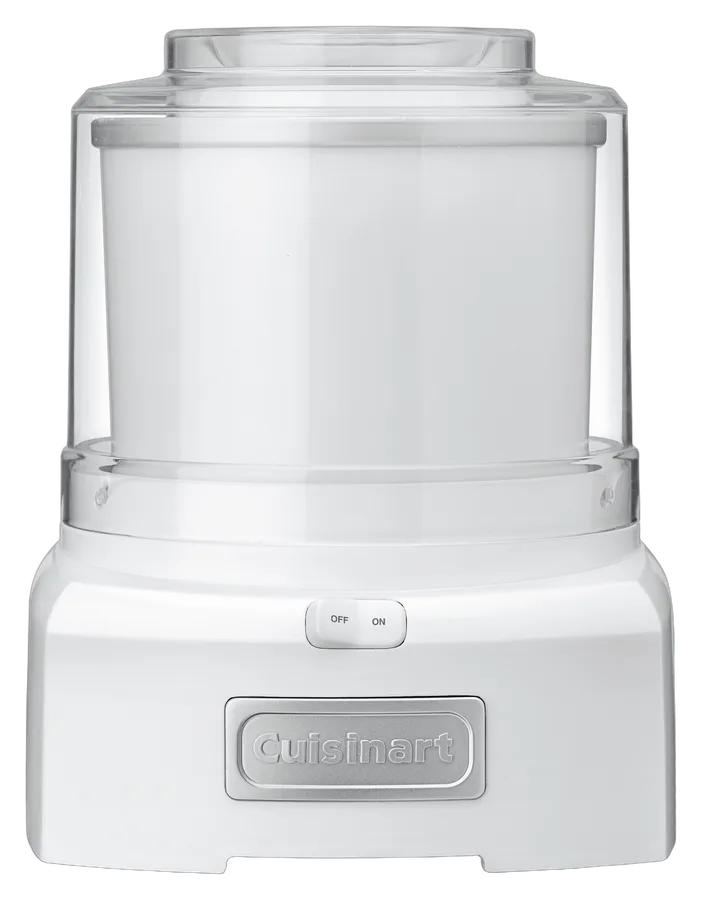
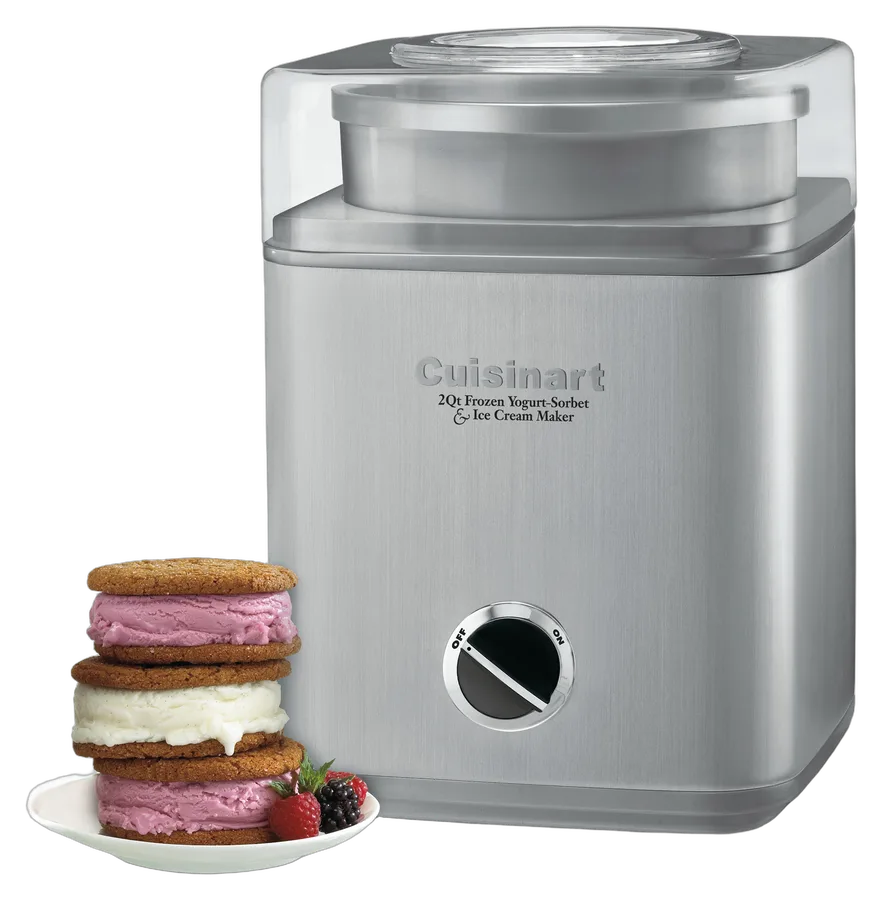
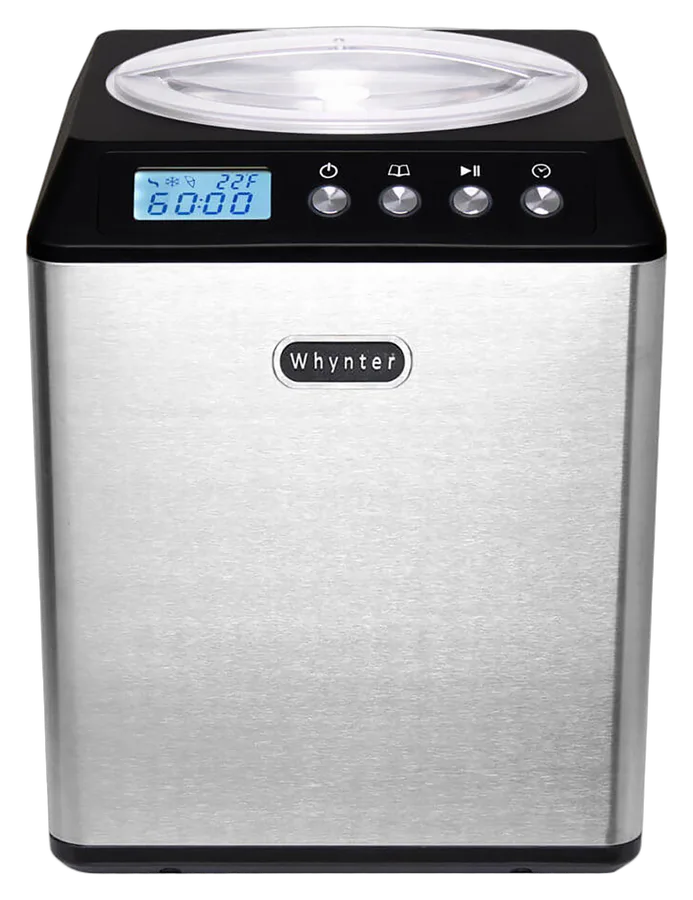
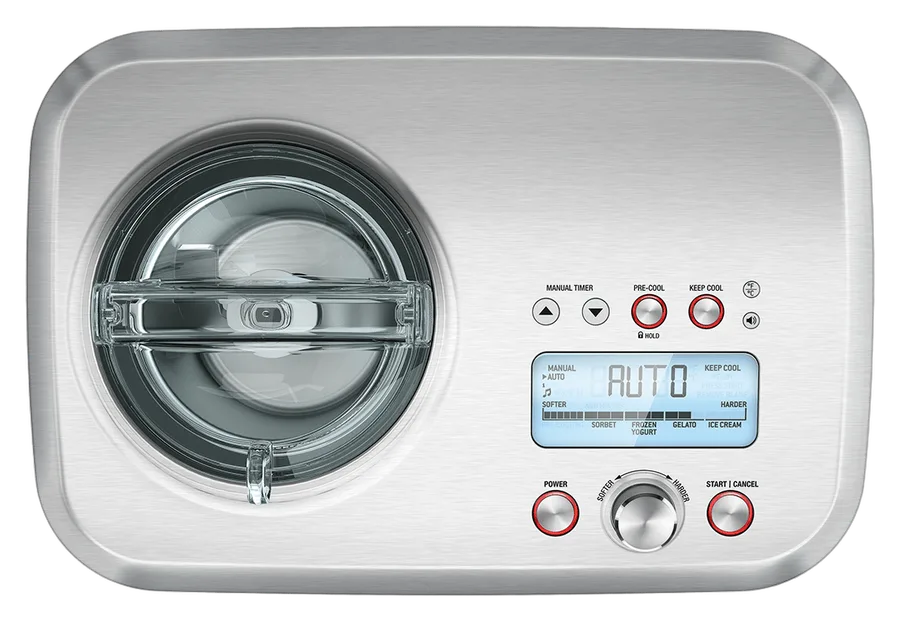
A home ice cream maker does one job: it freezes a chilled base against a very cold metal wall while a paddle keeps scraping the crystals off and stirring air in. How you prepare depends on where the cold comes from. A freezer bowl machine stores its cold in a bowl you freeze the day before. A compressor machine has its own refrigeration and is ready when you are. A stand mixer attachment is a freezer bowl driven by the mixer. This guide covers all three, with the figures each maker gives in its manual.
For pint-style machines like the Ninja CREAMi, which freeze the base first and shave it later, see how to use the Ninja CREAMi instead.
How does an ice cream maker work?
Food scientist H. Douglas Goff describes the commercial version: the mix runs through a barrel chilled by refrigerant, rotating blades keep scraping ice off the cold wall, and dashers whip in air. It comes out with about half its water frozen, at a consistency similar to soft serve, and is then hardened in a freezer (Goff, University of Guelph). A home machine does the same on a small scale:
- Freezer bowl. A double-walled bowl holds a cooling liquid between its walls. Once frozen, it pulls heat out of the base until the liquid inside thaws (Cuisinart ICE-21C booklet).
- Compressor. A small refrigeration unit chills the bowl continuously. Whynter lists a cooling range of -0.4°F (-18°C) to -31°F (-35°C) for the ICM-201SB (Whynter manual).
- Ice and salt. A canister turns in a bucket of ice and rock salt; salt brine gets far colder than ice alone. Covered in how to make ice cream.
KitchenAid's manual sums up the two stages neatly: churning is "conversion" to a soft-serve consistency, and the freezer does the "ripening" (KitchenAid KSMICM manual).
What do the manuals say? The figures side by side
| Machine | Type | Pre-freeze or prep | Churn time | Maximum batch | Firming in freezer |
|---|---|---|---|---|---|
| Cuisinart ICE-21 | Freezer bowl | Bowl 16 to 24 hours at 0°F (-18°C) | Under 20 minutes | 1 1/2 quarts (1.4 L), 1/4 inch (6 mm) below the rim | 2 hours or more |
| Cuisinart ICE-30BC | Freezer bowl | Bowl 6 to 22 hours at 0°F (-18°C) | 25 to 35 minutes | 2 quarts (1.9 L), 1/2 inch (1 cm) below the rim | 2 hours or more |
| KitchenAid KSMICM | Mixer attachment | Bowl at least 16 hours, freezer at coldest | 20 to 30 minutes on STIR | 46 oz (1.4 L) of base makes 2 quarts (1.9 L) | 2 to 4 hours |
| Whynter ICM-201SB | Compressor | Stand upright 2 hours before first use; no pre-freezing | 30 to 60 minutes (60 minute default timer) | 60 percent of the bowl, below the top of the paddle | Not stated |
| Breville Smart Scoop | Compressor | Upright 12 hours after transit; optional pre-cool 5 to 10 minutes | Around 50 minutes | 3 1/2 cups (828 ml) of liquid | 2 hours before serving in cones |
Sources: the manuals listed for this page. Freeze times differ even between two Cuisinart bowls, so follow the manual for your own machine.
How do you use a freezer bowl ice cream maker?
- Freeze the bowl. Wash and dry it, wrap it in a bag if you like, and freeze it upright on a flat surface at the back of the freezer, where it is coldest. Cuisinart says freezing takes 16 to 24 hours for the ICE-21C and 6 to 22 hours for the ICE-30BC, with the freezer at 0°F (-18°C).
- Check it. Shake the bowl. If you cannot hear liquid moving, it is frozen.
- Chill the base. See below. A warm base is the most common reason a freezer bowl fails.
- Assemble and start. Put the bowl on the base, set the paddle in, lock the lid, and switch on. Cuisinart says the ingredients must go in after the machine is turned on, and KitchenAid warns that pouring first can freeze the base onto the bowl and lock the dasher.
- Pour in the base. Straight through the spout, right away. The bowl starts to thaw the moment it leaves the freezer.
- Churn. Stop when it is as thick as you want: under 20 minutes in the ICE-21C, 25 to 35 in the ICE-30BC.
- Add mix-ins near the end. About 5 minutes before the end, through the spout, in pieces no larger than a chocolate chip (Cuisinart). KitchenAid says the final 2 minutes.
- Transfer and firm. Spoon it into an airtight container and freeze for 2 hours or more. Do not store it in the bowl: Cuisinart limits that to 30 minutes, since the dessert sticks and can damage the bowl.
A frozen bowl makes one batch. Cuisinart says the bowl must be completely frozen again before each use; a second bowl allows back-to-back batches. Never put the bowl back in the freezer wet, and do not put it in the dishwasher.
How do you use a compressor ice cream maker?
- Let it settle after delivery. Whynter says to stand the machine upright for about 2 hours before plugging it in so the refrigerant settles; Breville says 12 hours after transit.
- Pre-cool (optional). Breville's PRE-COOL brings the machine to about 14°F (-10°C) to -22°F (-30°C) in 5 to 10 minutes.
- Fit a dry bowl and the paddle. Whynter says the outside of the bowl must be completely dry. Breville says to insert the paddle before adding ingredients.
- Add the chilled base. No more than 60 percent of the bowl and not above the top of the paddle on the Whynter; no more than 3 1/2 cups (828 ml) of liquid on the Breville.
- Set the time or hardness. Whynter defaults to 60 minutes, adjustable. Breville's AUTO mode stops when the dessert reaches the hardness chosen on its dial (softer for sorbet, harder for ice cream); its MANUAL timer runs up to 180 minutes.
- Add mix-ins about 5 minutes before the end, once the mixture has thickened (Whynter).
- Keep it cold if you are not ready. Breville's KEEP COOL holds the dessert chilled and churned for up to 3 hours. Whynter's Extended Cooling starts on its own if the machine is not turned off within 10 minutes, cycling the compressor for up to 2 hours.
- Scoop out with plastic, not metal. Whynter says a metal scoop can scratch the bowl.
Compressor machines need no frozen bowl, so a second batch does not have to wait on the freezer, which is their main practical difference from a freezer bowl. Browse both kinds on the ice cream makers hub.
How long does an ice cream maker take?
| Stage | Freezer bowl | Compressor |
|---|---|---|
| Before you can start | 6 to 24 hours to freeze the bowl | None, or 5 to 10 minutes of pre-cooling |
| Chilling the base | Several hours or overnight | Several hours or overnight |
| Churning | About 20 to 35 minutes | About 30 to 60 minutes |
| Firming in the freezer | 2 to 4 hours | About 2 hours |
Churning time depends on the batch. Whynter says smaller batches and refrigerated ingredients finish faster; Breville names the room temperature, the ingredient temperature and pre-cooling. Whynter specifies a room between 60°F (16°C) and 90°F (32°C) for its machine.
How cold should the base be?
Cold. ThermoWorks says to get the base to 43°F (6°C) or below before churning, "especially if you have a frozen-bowl ice cream machine" (ThermoWorks). The manuals agree in their own words:
- Cuisinart: cooked bases should be chilled overnight, or chilled over an ice bath until completely cooled.
- Breville: make custard bases the day before, or cool them for at least 4 hours.
- KitchenAid: all bases need to be completely chilled in the refrigerator.
- Whynter: use a refrigerated mixture; warm ingredients are the first cause listed for ice cream that is not firm enough.
Custard bases with egg should be cooked to at least 160°F (71°C) before chilling (FDA, egg safety). The French vanilla ice cream recipe walks through a custard.
How full should an ice cream maker be?
Well short of the top. The base grows as air is churned in: KitchenAid's 46 oz (1.4 L) of base makes 2 quarts (1.9 L) of ice cream. Each maker sets its own limit (see the table above), and Whynter warns that overfilling can overflow. Too much base also slows freezing and leaves a soft result.
How do you ripen homemade ice cream?
Fresh from the machine, ice cream is soft-serve soft. For a scoopable texture, move it to a shallow, airtight container and freeze it 2 to 4 hours, as KitchenAid says, or 2 hours or more, as Cuisinart says. Breville adds two storage tips: press plastic film directly onto the surface to limit ice crystals, and keep frozen desserts for up to 2 weeks. When serving from the freezer, it suggests letting the dessert sit at room temperature for 5 to 10 minutes first.
What are the common mistakes?
| Mistake | What happens | What the manuals say |
|---|---|---|
| Bowl not fully frozen | Base never thickens | Freeze 16 to 24 hours and shake-test (Cuisinart) |
| Warm base | Soft, slow, or never firms | Chill completely first (all four makers) |
| Base poured in before starting | Freezes to the wall, locks the dasher | Start the machine, then pour (KitchenAid, Cuisinart) |
| Overfilling | Overflow, soft result | Stay within the maker's limit |
| Lid opened often | Ice cream not firm | Avoid opening the lid repeatedly (Whynter) |
| Mix-ins too early or too big | Paddle jams or motor stops | Add near the end, small pieces (Cuisinart, Whynter) |
| Low-fat base, undissolved sugar | Icy texture | Use whole milk; dissolve the sugar (Whynter) |
| Storing in the bowl | Sticks, can damage the bowl | Move to an airtight container (Cuisinart, KitchenAid) |
| Metal tools in the bowl | Scratches | Use plastic or wooden tools (Cuisinart, Whynter) |
One more from KitchenAid: freezing dulls sweetness, so a base will seem less sweet once frozen than it does as a liquid.
Quick answers
How long do you churn ice cream?
Until it looks like thick soft serve: about 20 to 35 minutes in a freezer bowl, 30 to 60 minutes in a compressor machine, 20 to 30 minutes in the KitchenAid attachment.
How long should an ice cream maker bowl freeze?
Cuisinart says 16 to 24 hours for the ICE-21C and 6 to 22 hours for the ICE-30BC; KitchenAid says at least 16 hours. Shake it: no sloshing means it is ready.
Can you make two batches in a row?
In a compressor machine, yes, since there is no bowl to refreeze. Cuisinart says a freezer bowl must be completely frozen before each batch, so back-to-back batches need a second bowl.
Why is homemade ice cream not freezing in the machine?
Usually a bowl that was not fully frozen, a base that was not cold, or too much base. Whynter adds a hot room and a lid opened too often.